


Introduction
Perpetual futures are complex and risky. The CME Group, which is the world’s leading derivatives marketplace and which knows a thing or two about futures products, agrees. Yet proponents of perpetual futures portray them differently. Kalshi describes perpetual futures as “the purest form of trading” and as products that are “very simple, very clean, and very accessible.” Indeed, it says that traditional futures “introduce additional complexity” because they are pegged to a specific date, whereas a perpetual “simply tracks whether or not the price of an asset goes up or down.” This is a complete misrepresentation of the nature of perpetual futures.
Traditional futures products are used to hedge risk. For example, a farmer who is worried that the price of wheat might decline between now and September 13 might sell a futures contract to lock in a price now. The futures contract allows the trader to mitigate risk as of a fixed date.
Perpetual futures contracts have no expiration date. Their purpose is not for hedging but for speculation. And they allow traders to speculate by using leverage. This means traders are able to control positions worth many times more than their initial investment. This use of leverage may amplify gains, but it may also aggravate losses. This is what makes perpetual futures so risky.
Another financial product that uses leverage and that reveals the risks for retail investors is single-stock exchange-traded funds (ETFs). These ETFs track the price of a single stock, but they use leverage to magnify the gains or losses when the stock price goes up or down. Again, the ability to use leverage can lead to large gains, but it can just as easily lead to large losses.
The SEC approved single-stock ETFs four years ago. At the time, Commissioner Crenshaw warned that they presented “a high level of risk” for retail investors “by virtue of their leveraged and inverse exposure to a single stock.” Unfortunately, Commissioner Crenshaw’s fears have been realized. Retail investors experienced significant losses in single-stock ETFs after they were approved. Regulators should not make the same mistake with perpetual futures as with single-stock ETFs.
Perpetual Futures and the Use of Leverage
A perpetual future is a contract with no expiration date that offers the ability to trade on the price of an asset without owning the asset. The trader is not buying the right to purchase a commodity at a certain price on a certain date. Instead, the perpetual futures contract essentially allows the trader to speculate on the price of the underlying asset. It is a bet on whether the price will go up or down. The trader is able to hold the contract indefinitely because there is no expiration date.
The way perpetual futures work is that they use leverage. As Kalshi says, leverage allows the trader to trade a larger position with less upfront cash. Although this can lead to larger profits, it can increase the speed at which losses accumulate and increase the odds of a total loss.
As an example, a trader who wants to bet that the price of Bitcoin will increase could open up a long position in a Bitcoin perpetual futures contract with 10x leverage. If the trader starts with $1,000, this gives her exposure to a $10,000 position. If Bitcoin’s price rises by 5%, the trader earns a 50% return, or $500. However, if Bitcoin’s price declines by 5%, the trader loses $500—half of the original investment. As this example shows, through the use of leverage, a small change in the price of the underlying asset can quickly lead to the loss of the entire investment.
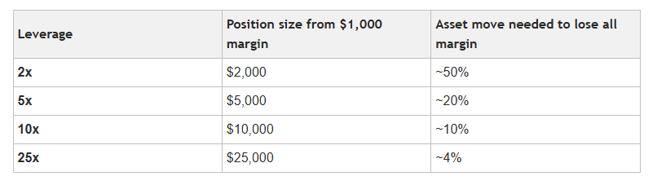 Source: Kalshi
Leverage can even exceed these thresholds. The rules of the Commodity Futures Trading Commission (CFTC) do not restrict the amount of leverage exchanges may offer; instead, each platform sets its own leverage limits. Some exchanges offer perpetual futures on U.S. stocks and indexes with leverage up to 50x. Globally, investors can access perpetual futures with leverage as high as 500x. One study of Binance users showed that almost 80% of customers traded with 20x leverage, with almost 20% of customers using over 100x leverage. Because leverage makes it easy to lose money quickly, even proponents of perpetual futures recognize that “financial losses may be substantial if market prices move sharply against the trader’s position.”
Single-Stock ETFs and the Use of Leverage
Single-stock ETFs are similar to perpetual futures in that they track the price of an underlying asset—a single stock. They are also similar because they use leverage. As a result, they pay positive or negative multiples of the market performance of the underlying stock.
Single-stock ETFs reset their value daily. So, unlike perpetual futures, they are not meant to be held for more than a day. Like perpetual futures, however, their use of leverage can lead to large losses and losses that diverge significantly from the price movements of the underlying assets.
For example, if the price of the stock is $1,000, with a 2x leveraged ETF tracking that stock, a 10% loss over the course of a day will cause the price of the stock to decline to $900, but the price of the ETF to decline to $800. If the price of the stock rises 10% the next day, the price of the stock will close at $990, but the price of the ETF will only rise to $960. So, over the two days, the stock lost just 1%, but the ETF lost 4%. As a result of the leverage, “investors holding these funds will experience even greater volatility and risk than investors who hold the underlying stock itself.”
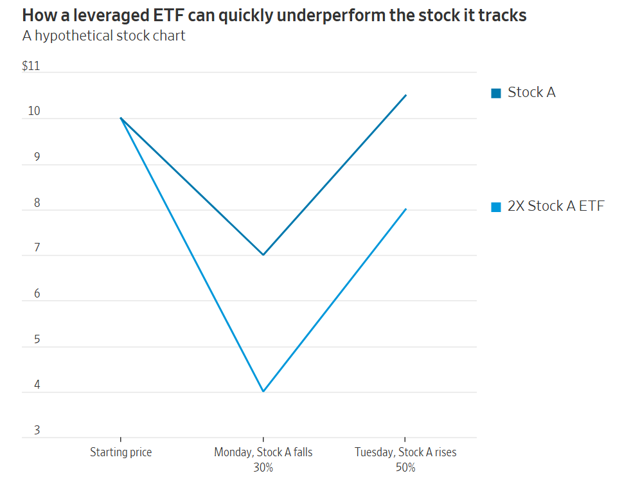
Source: The Wall Street Journal
This is why the SEC’s Investor Advisory Committee recommends that the SEC require brokers to display a graph showing the divergent performance of the single-stock ETF and the underlying asset at the point of sale before they allow customers to purchase the single-stock ETF.
The ability to use leverage to magnify gains is why single-stock ETFs are marketed to retail investors. But because leverage can also magnify losses, which may increase the longer a single-stock ETF is held, they are “inappropriate for almost all investors.” This is why the consensus is now that single-stock ETFs “will eventually maul” the retail investors at whom they are targeted.
Retail Investors’ Losses from Single Stock ETFs
Indeed, retail investors often suffer losses in single-stock ETFs. For example, investors who bought a 2x leveraged ETF tracking the price of bitcoin holding company Strategy in 2025 lost huge:
Last November, two recently launched ETFs that offered to double the daily returns of bitcoin-linked stock MicroStrategy (now known as Strategy) began to soar. The outsize gains attracted attention on social media, and thrill-seeking individual investors began to pile in at a pace never seen befPerpetual Futures and Single Stock ETFs Fact Sheetore for a leveraged single-stock fund. Many of those investors are now sitting on huge losses, despite the fact that the underlying Strategy shares are up over the past year. Strategy shares rose 28% in the 12 months ended Wednesday, while one of the leveraged funds, the Defiance Daily Target 2x Long MSTR ETF, plunged 65%.
The returns on a 2x leveraged ETF tracking Tesla tell a similar story:
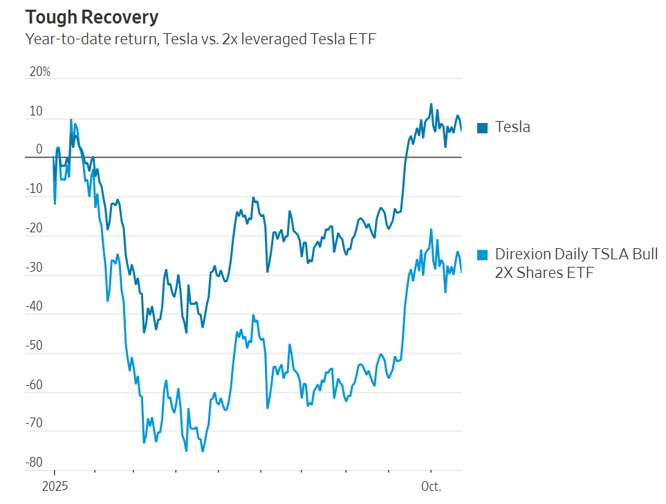
Source: The Wall Street Journal
And in January 2025, when shares of Nvidia fell, three 2x leveraged single-stock ETFs tracking Nvidia’s price lost 33% of their value in a single day, calling into question the reliability of the ETFs. This is why single-stock ETFs are considered “way too risky for 99% of investors.”
Single-stock ETFs are so risky that South Korea, which approved these ETFs in April, requires investors to sit through hours of instruction and take an exam before they may buy the funds.
Conclusion
As shown above, perpetual futures are a far cry from the “simple” products that proponents portray. Even some firms that promote perpetual futures acknowledge that they are “for advanced traders who want flexibility around the clock.” For individual investors, they are far too risky.
The same is true of single-stock ETFs. They are “designed for traders, not investors.” Yet nearly 90% of trading in leveraged single-stock ETFs can be traced to transactions by individual investors. So, there is a mismatch between who single-stock ETFs are for and who they are used by. The name implies that they are simple products that retail investors want in their portfolios. And retail investors are lured in by the promise of high returns without necessarily realizing that the leverage involved may amplify their losses too. Indeed, the losses retail investors suffered in single-stock ETFs discussed above arose because investors “misunderstood how leveraged funds work.”
This was foreseeable. Indeed, Commissioner Crenshaw foresaw it. Yet regulators appear poised to make the same mistakes with perpetual futures. The risks are even greater with respect to perpetual futures because the SEC has limited single-stock ETFs to 2x leveraged ETFs; perpetual futures will offer leverage that is much higher. Instead of safeguarding retail investors from the risks perpetual futures pose, the CFTC has facilitated their exposure to these risky products. And it has done so without adopting any investor protections, such as disclosure requirements to ensure that investors understand the risks from the use of leverage. Four years after the approval of single-stock ETFs, the regulators who are supposed to protect investors are once again endangering them by approving supposedly simple products that are actually unduly risky.
###
Better Markets is a non-profit, non-partisan, and independent organization founded in the wake of the 2008 financial crisis to promote the public interest in the financial markets, support the financial reform of Wall Street and make our financial system work for all Americans again. Better Markets works with allies—including many in finance—to promote pro-market, pro-business and pro-growth policies that help build a stronger, safer financial system that protects and promotes Americans’ jobs, savings, retirements and more. To learn more, visit www.bettermarkets.org.Perpetual Futures and Single Stock ETFs Fact Sheet


