


Introduction
Kalshi and Polymarket, two large financial firms seeking to maximize their profits, have unleashed unregulated nationwide gambling by allowing bets on everything from sports and politics to the Golden Globe awards and the return of Jesus Christ, all without any involvement of policymakers, elected officials, or consideration of the public interest. Given the involvement of organized crime and financial predators in gambling for more than 100 years, the public interest in properly regulating gambling is extremely high. States have historically done this to protect customers and keep criminals out, but these two firms have complied with none of those public interest regulations. With gambling increasing every day – largely due to unending marketing by Kalshi and Polymarket and many other gambling sites – and more than $2 billion being bet on Kalshi every week, the need for proper regulation is greater now than ever before.
Kalshi and Polymarket operate what they call “prediction markets,” which are effectively gambling sites where users can bet money on whether an event will occur, such as which candidate will win an election or which sports team will win a game. Prediction markets are virtually indistinguishable from a casino, a street corner bookie, a gambling app, or any other place you can place bets. They call themselves prediction markets to avoid longstanding regulation by the states, which have regulated gambling for many decades to protect customers and reduce the involvement of organized crime and other financial predators.
Like most gambling sites, Kalshi and Polymarket show the odds that an event will occur, which are based on how much money other users place on whether it will or won’t. Users can then bet, based on those odds, “yes” or “no” as to whether they think the event will happen.
Kalshi and Polymarket contend that by letting the world know what the “crowd” thinks will happen, their sites provide valuable information that is more accurate than polls or prognostications. The problem is that, absent inside information, the users on these sites are no more likely to know whether a candidate will win an election or a team will win a game than anyone else.
The fact is, prediction markets are not real markets. Real markets are properly regulated to ensure that the activity is real, that there is a level playing field, and that participants make good on their trades. That results in genuine trading and fair dealing among participants. Real markets have a regulator to prevent conflicts of interest and to stand between the buyer and seller to ensure the well-functioning of the market. None of that is applicable to these so-called prediction markets.
Prediction markets also are not a representative sample of the public. Instead, they are dominated by young men. These young men have a greater-than-average risk appetite and are prone to gambling in all of its traditional forms. So the individuals participating in these “markets” are a very small and arguably unique slice of the American people with no special aptitude or ability to predict the future. This makes it hard to extrapolate anything of value from the odds posted on these sites. Instead, the odds reflect what odds on gambling sites always reflect—the potential payout from placing a bet on an event with an uncertain outcome. Prediction markets don’t foretell the result of elections or sporting events; they just make it easier to bet on them, which generates little real value and endangers the social, political, and economic health of our communities.
Political Prediction Markets Do Not Forecast the Future
Scant evidence establishes that prediction markets are an accurate predictor of what will happen in an election. Indeed, recent findings from Vanderbilt researchers Joshua Clinton and TzuFeng Huang “challenge the view that prediction markets necessarily efficiently and accurately aggregate information about political outcomes.” Political prediction markets do not tell the world what will happen; instead, they simply facilitate betting on elections.
The unprecedented prospect of countless political races becoming gambling opportunities raises serious issues—namely, the potential for election interference and market manipulation.
- The ability to profit on electoral outcomes incentivizes election interference. AI, deepfakes, and other nefarious activities to attack candidates can easily impact betting activity and odds, as well as the outcome of elections. Users could profit from spreading misinformation and betting on the electoral outcome that they themselves manipulated.
- Political prediction markets also may be manipulated. In many races, there won’t be much betting activity, so small bets will move the odds significantly. Users could place bets to give the false impression that a candidate has increasing (or decreasing) support.
Political prediction markets are particularly susceptible to one form of market manipulation: insider trading. Anyone with knowledge of important nonpublic events (i.e., a big endorsement, a major campaign contribution, a significant hire or resignation on the campaign staff, etc.) could place bets shortly before the event becomes public. If they closed out their bet shortly after, they could pocket big winnings. And because there is always someone on the other side of the bet, prediction markets are zero sum games. Thus, whatever someone wins comes at the expense of those who lost, so using inside information in this way would be nothing more than stealing.
Real world evidence bears this out. Shortly before President Trump announced the capture of Venezuelan leader Nicolas Maduro, an anonymous Polymarket user placed a $30,000 bet that Maduro would not still be in power on January 31. That user pocketed $436,000 in winnings.
For most people, Maduro’s capture seemed to come out of the blue. The odds that he would be captured were only 6.5% on Polymarket on the afternoon of January 2, but they jumped to 11% shortly before midnight and surged thereafter, indicating a sudden change in positions. The bet on Maduro’s capture therefore had all the hallmarks of a trade based on inside information.
Maduro’s capture shows not only the potential for insider trading and market manipulation but also the inaccuracy of prediction markets on political events. The anonymous user was able to profit because Maduro’s capture was considered unlikely. The fact that the odds of his capture were in the teens or single digits means that users overwhelmingly thought it likely that Maduro would remain in power through the end of January. Putting aside the issue of insider trading, prediction markets were overwhelmingly wrong about whether Maduro would remain in power.
The users who bet Maduro would remain in power all lost huge, but another problem with political prediction markets is that sometimes it is not clear who won or lost. For example, before Maduro’s capture, Polymarket allowed users to bet on whether the US would “invade” Venezuela. Users did so, and there is now a dispute over whether the U.S. military action in Venezuela and Maduro’s ensuing capture constituted an “invasion.” Unsurprisingly, the people who bet the U.S. would invade believe that the complex, multifaceted military operation involving 150 U.S. military aircraft, dozens of warships, and the most elite units in the military was an “invasion” and want to be paid their winnings. However, without defining what constitutes an “invasion” from its point of view, Polymarket is taking the position that there was no invasion. Regardless of who is right or wrong, prediction markets do not seem like a source of valuable information if there is a lack of clarity about what the facts are or how to characterize them.
Sports Prediction Markets Are Unregulated Sportsbooks
Although Kalshi initially attempted to distinguish its political prediction markets from gambling by saying that it was not the same as sports betting, sports betting now accounts for around 90% of the trading volume on Kalshi. There is even less of a basis to view prediction markets as a source of valuable information, or as anything other than a casino, when it comes to sports. These markets are nothing more than unregulated sportsbooks.
There is no functional difference between traditional sportsbooks and prediction markets when it comes to sports. On both platforms, you can wager money on which team will win a game (or whether certain players will reach specific statistical benchmarks or any number of other bets). As NCAA president Charlie Baker recently said with respect to college sports, Kalshi and Polymarket are simply “offering what anyone can see is unregulated betting on college games.”
One glance at Kalshi’s website is sufficient to establish that what Kalshi is offering is the ability to bet on sports. This is what its website looks like for the Super Bowl on February 8:
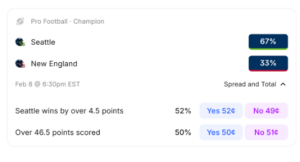
Despite their name, prediction markets are not accurate forecasts of who will win. For example, prediction markets favored the Chiefs over the Eagles in last year’s Super Bowl, but the Eagles won handily. Prediction markets let people bet on sports; they offer no insight into who will win.
As a result, prediction markets should be regulated like traditional sportsbooks. Nobody would say that MGM in Las Vegas is “making a market” in NFL bets or creating a “blackjack market” or doing anything other than running a casino. Kalshi and Polymarket should be treated similarly.
As it stands, Kalshi and Polymarket should be viewed as even less reliable platforms because they are unregulated. Traditional sportsbooks and betting sites like FanDuel and DraftKings must comply with state laws that regulate gambling. Prediction markets lack “the expertise, track record and strict rules that sportsbooks are required to follow” that ensure the integrity of the betting activity and that allow sports leagues to identify games that have been manipulated.
The absence of any regulation makes it all too easy to potentially manipulate betting activity. For example, Kalshi and Polymarket partner with X accounts that claim to be sports insiders but actually disseminate false information about sporting events. This false information could change the odds on the sites and allow informed users to profit; Kalshi itself explains how users could profit after a shift in the odds of an event by closing out the bet before the event occurs.
It’s not only sportsbooks and casinos that voice these concerns; the institutions that oversee sports view prediction markets as a threat to the public. Baker, the NCAA president, warned recently that prediction markets should not offer betting on collegiate sports “until a more robust system with appropriate safeguards is in place.” He noted that prediction market operators “are not required to report integrity concerns to other operators through an intermediary—a requirement for sportsbooks in most states.” Far from providing value to society, the unregulated nature of sports gambling on prediction markets means they leave the public unprotected.
“You’re basically talking about no rules, no oversight, no nothing. And that just feels catastrophic to me,” said [Baker], in an interview with Yahoo Sports.
Kalshi and Polymarket say they are regulated by the Commodity Futures Trading Commission (CFTC), the financial regulator for the derivatives market. But the CFTC has no expertise in regulating election betting or sports gambling. And the CFTC has done nothing to regulate prediction markets so that they do not threaten the integrity of our elections or sporting events.
The CFTC Has No Business Regulating Bets on Elections or Sports
The CFTC regulates event contracts, which are supposed to be derivatives contracts that have real economic value in connection with commodities or financial assets. CFTC-regulated event contracts are supposed to be legitimate hedging tools to minimize a legitimate financial risk, such as the risk that future events might impact the supply and therefore the price of commodities like wheat, corn, oil, gas, or pork bellies that are produced today for future delivery. An event contract on politics or sporting events is not a legitimate hedging tool for anything.
Nonetheless, Kalshi and Polymarket style their offerings on politics and sports as “event contracts” and say their prediction markets fall under the CFTC’s jurisdiction as a result. This is nothing more than regulatory arbitrage—an attempt to use semantics to obtain more favorable regulatory treatment. They are trying to proliferate unregulated gambling on the country. They are trying to elevate the form of their offerings (event contracts) over the substance of their offerings (gambling) to avoid state and tribal) regulation of gambling, which has been the law of the land for many decades and which protects the public in states where gambling is legal.
One reason Kalshi and Polymarket want to be regulated by the CFTC is that the CFTC lacks the ability to regulate them effectively. Even before losing approximately 20% of its staff in 2025, the CFTC was the smallest, least funded, least capable financial regulator in the U.S. The CFTC lacks the resources to execute its core mission of overseeing the commodities and derivatives markets to ensure that prices for essential goods like food, gas, and electricity reasonably reflect supply and demand. The CFTC simply doesn’t have the budget, personnel, experience, technology, bandwidth, or expertise to regulate prediction markets that are essentially casinos. So Kalshi and Polymarket want to be “regulated” by a regulator that has no business regulating them.
Kalshi and Polymarket also want to be under the CFTC because the CFTC has allowed them to provide unregulated gambling under the guise of offering event contracts. The CFTC may prohibit event contracts that reference terrorism, assassination, war, gaming, or other actions deemed illegal under federal or state law. Many states prohibit betting on elections, and sports gambling obviously implicates gaming. Nevertheless, the CFTC has not acted. Although the CFTC attempted to quash Kalshi’s attempts to offer “event contracts” on elections during the Biden administration, it abandoned those efforts after the 2024 election. And it has done nothing during the Trump administration to prohibit “event contracts” on sporting events—despite Congress’s clear intent to authorize the CFTC to prevent companies from offering event contracts on “sporting events such as the Super Bowl, the Kentucky Derby, and Masters Golf Tournament,” which would “not serve any real commercial purpose” but would “be used solely for gambling.”
In the CFTC’s absence, the states have attempted to fill the void. Many states (and some tribes) have instituted legal proceedings against Kalshi to require it to cease its sports betting activity because it violates clear state law. The courts have yet to rule definitively, but several judges have found Kalshi is violating the law by allowing prediction markets on sporting events.
- A federal judge in Nevada found that event contracts that turn on the outcomes of sporting events “do not fall within the CFTC’s exclusive jurisdiction.” The judge said that comprehensive regulation and strict licensing standards at the state level would protect consumers, including children and “problem” gamblers. The judge also ruled that Kalshi’s argument “would require all sports betting across the country to come within the jurisdiction of the CFTC rather than the states and Indian tribes,” which would upset “decades of federalism regarding gaming regulation, is contrary to Congress’s intent . . . and cannot be sustained;” the judge ruled further that Kalshi’s argument that it was only subject to the CFTC’s jurisdiction was simply “an attempt to evade state regulation.”
- A federal judge in Maryland found that Congress did not intend for the CFTC “to preempt state gaming laws when sports wagers are made on a platform like Kalshi’s” and it was “highly unlikely” Congress wanted the CFTC “to override state laws that regulate sports betting.”
- A federal judge in Massachusetts found that “logic does not suggest Congress intended to displace traditional state . . . gambling regulation.” The judge said there could be “little question that Kalshi well understood that its business model-especially once it began offering bets on sporting events—came into direct conflict” with state law. The judge ruled that there was “no real question that licensure, and consequent oversight, of sports wagering operations” such as Kalshi’s “serves both public safety and health.”
These judges recognized that prediction markets do not disseminate valuable information or predict future events but rather simply facilitate betting on sports without consumer protections.
Conclusion
Prediction markets threaten everyday Americans by posing as accurate forecasters when they are really nothing more than unregulated casinos, but the even greater danger is the increasing integration of prediction markets with traditional finance and the news. Intercontinental Exchange, the owner of the New York Stock Exchange, recently invested $2 billion in Polymarket. If the NYSE or other financial firms integrate gambling into the core of their financial activities, then it would raise serious safety and soundness concerns as well as financial stability risks.
No less troubling are the partnerships between Kalshi and Polymarket and the news media. CNN is now partnering with Kalshi to include Kalshi’s odds as part of its news coverage. The Wall Street Journal is partnering with Polymarket so that the betting odds for politics and cultural events will be displayed on its platforms. These and other media outlets are substituting actual reporting for the odds posted on what is essentially a casino. The opinions of an unrepresentative subset of the American people are being cast as accurate factual information. For example, you can go on Kalshi to bet on who the next Fed Chair will be. But how is the “wisdom of the crowd” supposed to reflect the actual probability of Kevin Warsh, Kevin Hassett or anyone else being the next Fed Chair? Only a handful of people know the answer. The media is supposed to do reporting to find out who it will be. Instead, media outlets are replacing reporting with the odds of an event happening based on the predictions of those who have no idea and are merely guessing.
Prediction markets are simply casinos. We should not make them ubiquitous. Instead, we should regulate them as the casinos they are so the American people have the protections they deserve.


