

Introduction
In August, Kanye West launched a meme coin—a type of crypto asset inspired by a celebrity or internet trend that is often heavily promoted and hyped. The coin surged almost 1000% in value in the minutes after its launch. However, within a week, it plunged 80% in value and led over 51,000 traders to lose $74 million. This fact pattern is known as a rug pull in the world of crypto. It involves a group of insiders hyping a token, driving up its price, and then selling their tokens. This leaves the insiders with enormous profits and the investing public with worthless tokens.
This fact pattern bears a striking similarity to penny stock pump-and-dumps. The SEC describes a pump-and-dump scheme as one where fraudsters spread false or misleading information to create a buying frenzy that will “pump” up the price of a stock and then “dump” shares of the stock by selling at the inflated price. This causes the price to fall and investors to lose money. Due to their speculative nature, penny stocks are particularly susceptible to pump and dumps.
Despite these similarities, the regulatory treatment of meme coins and penny stocks couldn’t be more different. The SEC takes the view that meme coins are not securities but collectibles. This means they are excluded from coverage under the federal securities laws.
Conversely, the SEC has long regulated penny stocks. It has brought innumerable cases against perpetrators of penny stock pump and dumps. In doing so, it has been aided by legislation designed to specifically address misconduct in the penny stock space.
This is the 35th anniversary of the Penny Stock Reform Act of 1990. Congress enacted the Penny Stock Reform Act to protect retail investors against the abusive and fraudulent sales practices prevalent in the penny stock market such as boiler rooms and pump-and-dump schemes.[i] The act “required penny stock brokers and dealers to disclose information about specific stocks offered and the penny stock market in general to customers before purchase.”[ii] It also “granted the SEC authority over penny stock issuers, brokers, and dealers.”[iii] So the Penny Stock Reform Act “attacked the factors that made penny stocks vulnerable—lack of information and little regulatory oversight.”[iv] We need a similar legislative and regulatory response for meme coins.
Penny Stock Reform Act
The Penny Stock Reform Act provided protections to investors and addressed the fraudulent sales practices that had long characterized the market for penny stocks.[v] These sales practices “were known as ‘pumping and dumping’ or ‘churning’ stocks.”[vi] Brokers convinced investors to buy penny stocks based on false or exaggerated information.[vii] They then sold the stocks while their values were inflated.[viii] The companies profited while investors suffered losses.[ix] These schemes were “facilitated by a shortage of reliable information regarding penny stocks, without which investors could not make informed investment decisions.”[x] This factor, “coupled with the loose regulatory scheme governing the penny stock market, allowed for a market that fostered, if not encouraged, the emergence of unorthodox and unscrupulous investment vehicles.”[xi]
As a result, prior to the passage of the Penny Stock Reform Act, there was an epidemic of penny stock fraud.[xii] 90 percent of investors lost part or all of their investment.[xiii] Even absent fraud, 70 percent of investors lost money in penny stocks.[xiv] Individual investors suffered billions in losses due to the illegal and unscrupulous securities trading practices that pervaded the penny stock market.[xv] In 1989, the North American Securities Administrators Association (NASAA) concluded that “[p]enny stock swindles [were] . . . the No. 1 threat of fraud and abuse facing small investors in the United States.”[xvi] Then-SEC Chairman David Ruder said penny stock fraud was “one of the most menacing problems facing investors, regulators, and the legitimate securities industry.”[xvii]
Congress enacted the Penny Stock Reform Act to redress this situation. The act was designed to stop fraud and abuse in penny stocks “by allowing the SEC to impose special suitability and disclosure requirements” on penny stock offerings.[xviii] The act directed the SEC “to promulgate rules imposing special disclosure requirements for offerings by blank check companies,” which were “any company issuing penny stock.”[xix] Under this authority, the SEC adopted Rule 419.[xx] Rule 419 “established requirements for every registration statement filed by a blank check company, creating significant protections for investors.”[xxi] Rule 419 “had ‘an immediate and dramatic positive effect on abuses’ in the penny stock market, as its promulgation all but eliminated blank check companies from the United States securities industry.”[xxii] Overall, the Penny Stock Reform Act “curtailed the rampant abuse in the penny stock market.”[xxiii]
Meme Coins
We need a similar response to the scams and abuses that plague meme coins and that cause investor losses. Kanye West’s meme coin is just one example of how investors can lose money investing in meme coins by falling victim to scams akin to penny stock pump-and-dumps. Unfortunately, there are hundreds of other meme coins with a similar story.
Whilst the crypto industry has progressed and moved on following the spectacular implosion of FTX, hacks and scams are still rife with bad actors embezzling millions of dollars worth of assets by capitalizing on investor greed. The memecoin sector is the greatest example of that, with 10s of thousands of bogus tokens being created every day.
A recent report by Solidus Labs found that 98.6% of meme coins launched on Pump.fun were rug pulls or pump and dump schemes. Pump.fun is a Solana-based meme coin generator that allows users to launch their own meme coins without technical expertise. The Solidus Labs report also found that more than 7 million meme coins have been issued on Pump.fun since its inception in January 2024, with just 97,000 of them maintaining at least $1,000 in liquidity.
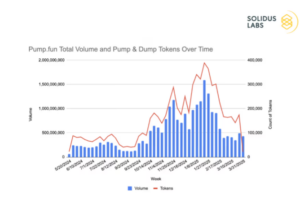 Chart showing Pump.fun volume (Solidus Labs)[xxiv]
Fraud is not the only reason we need to regulate meme coins. Their speculative nature, illiquidity, and lack of transparency means that they are highly volatile and susceptible to large price swings. As a result, crypto’s recent crash has hit meme coin investors particularly hard. As Bloomberg reported, meme coins “were among the broad swathe of digital assets known as altcoins that were hit hardest during the crash in crypto prices” in October 2025. Investors have suffered large losses and lost confidence in meme coins as a result, as Bloomberg also reported:
Crypto’s riskiest tokens are crashing on a scale that stands out even by the industry’s own volatile standards, abandoned by retail speculators saddled with humiliating losses and a growing sense that the game is rigged.
The only way to prevent these losses is to enact investor protections in the meme coin space, similar to the protections that Congress and the SEC adopted to combat penny stock fraud.
SEC Statement on Meme Coins
Unfortunately, the SEC is doing the opposite. Earlier this year, the SEC issued guidance from its staff purporting to declare that transactions in meme coins generally do not involve the offer or sale of securities. Instead, the staff said meme coins are akin to “collectibles.”
This is ridiculous. Meme coins are not rare. People do not try to collect a set of meme coins. And people do not buy meme coins so they can trade them for other meme coins. Instead, people buy meme coins because they have a fear of missing out (FOMO) on the gains meme coins supposedly offer.[xxv] In other words, people buy meme coins as an investment.[xxvi]
Nonetheless, the SEC’s view the meme coins are collectibles means that, according to the SEC, purchasers of meme coins are generally not protected by the federal securities laws. Given the risks, and the fact that most people purchase meme coins as an investment, this is astounding.
It is also a recipe for disaster, and penny stocks offer a cautionary tale. The fraud that led to the enactment of the Penny Stock Reform Act was preceded by “a decade of massive growth in the securities markets.”[xxvii] At the same time, “marketing securities to potential customers became less onerous as communication technology . . . became less expensive and more accessible to brokerage firms.”[xxviii] So the growth in the securities markets was accompanied by “a substantial increase in the magnitude and frequency of fraud and corruption in the securities markets.”[xxix] Yet while “securities fraud grew, the SEC’s power of enforcement and review did not, resulting in an impotent agency that was ‘horribly overmatched by the bad guys in the marketplace.’”[xxx]
The Penny Stock Reform Act attempted to redress this situation. We must take similar action with respect to meme coins. The crypto industry is experiencing its own massive growth. And it is even easier to peddle meme coins to investors today than penny stocks to investors in the 1980s. We must not allow our regulators to become overmatched by fraudsters in the crypto space.
Conclusion
Almost exactly one year ago, Azeem Khan, the co-founder of Miden, a privacy-focused blockchain project, wrote an article in CoinDesk warning that the “perception of memecoins as a quick, easy way to win a digital lottery and become an overnight millionaire is deeply flawed.” Khan thought that “people investing their hard-earned money into these digital lotteries need a clearer understanding of what they’re entering into.” The picture Khan painted was stark:
Critics often argue that memecoins are just a rehash of Jordan Belfort’s “Wolf of Wall Street” era—a world of unregulated securities and insider trading. This time, however, the penny stocks have been replaced by on-chain memes financialized in ways that make it seem like anyone can create and profit from them. . . . The truth is, many of these projects . . . are nothing more than anonymous pyramid schemes in disguise.
Khan warned potential meme coin investors that “knowledge is your best defense.” That is true, and that is why those of us who see the obvious parallels between meme coins and penny stocks believe we need a version of the Penny Stock Reform Act for meme coins. That act, and the rules the SEC adopted under it, brought transparency and governance to a previously opaque and unregulated part of the securities markets. Congress and the SEC recognized the need for rules governing penny stocks 35 years ago. We must recognize the same need for meme coins now.
Endnotes
[i] Amendments to the Penny Stock Rules, 69 Fed. Reg. 2531, 2537 (Jan. 16, 2004).
[ii] Erin Bauwens, The Dodd-Frank Act and Government Overreach: How Expanded SEC Authority Affects the Investing Public and How to Better Regulate the Financial Industry, 67 Syracuse L. Rev. 741, 747 (2017).
[iii] Id.
[iv] Allison N. Swecker, To SPAC or Not to SPAC: Liberalizing The Regulation of Capital Markets, 56 Vand. J. Transnat’l L. 579, 587 (2023).
[v] 69 Fed. Reg. at 2539.
[vi] Bauwens, 67 Syracuse L. Rev. at 747.
[vii] Id. at 746.
[viii] Id.at 746-47.
[ix] Id. at 747.
[x] Daniel S. Riemer, Special Purpose Acquisition Companies: Spac and Span, or Blank Check Redux?, 85 Wash. U. L. Rev. 931, 935 (2007) (citing H.R. Rep. No. 101-617, at 10, as reprinted in 1990 U.S.C.C.A.N. 1408, 1412).
[xi] Id. at 936.
[xii] Swecker, 56 Vand. J. Transnat’l L. at 586 (citing Gregory A. Robb, Fraud Cited in Penny Stocks, N.Y. Times (Sept. 7, 1989), https://www.nytimes.com/1989/09/07/business/fraud-cited-in-penny-stocks.html).
[xiii] Id. (citing Robb, supra note xii).
[xiv] Id. (citing Robb, supra note xii).
[xv] Riemer, 85 Wash. U. L. Rev. at 934 (citing S. Re. No. 101-337, at 2 (1990)).
[xvi] Id. at 935 (alterations in original) (citing H.R. Rep. No. 101-617, at 8, as reprinted in 1990 U.S.C.C.A.N. 1408, 1410).
[xvii] Samantha K. Keleher, SPACs and the Present Regulatory Conundrum, 16 Va. L. & Bus. Rev. 357, 361 (2022) (quoting H.R. Rep. No. 101-617, at 7 (1990).
[xviii] Jerry W. Markham, Guarding the Kraal—On the Trail of the Rogue Trader, 21 J. Corp. L. 131, 132 n.6 (1995).
[xix] Thomas Lee Hazen, Rational Investments, Speculation, or Gambling—Derivative Securities and Financial Futures and Their Effect on the Underlying Capital Markets, 86 Nw. U. L. Rev. 987, 1034 n.266 (1992).
[xx] Tyler J. Martin, The Agency Problem in SPACs: A Legal Analysis of SPAC IPO Investor Protections, 95 S. Cal. L. Rev. 1209, 1240 (2022).
[xxi] Id.
[xxii] Riemer, 85 Wash. U. L. Rev. at 943 (quoting David N. Feldman, Reverse Mergers: Taking a Company Public Without an IPO 45 (2006)); see also Use of Form S-8 and Form 8-K by Shell Companies, 2004 WL 824095 (Apr. 15, 2004) (“We believe that Rule 419 has been successful in deterring fraud and and abuse in public blank check offerings.”).
[xxiii] Martin, 95 S. Cal. L. Rev. at 1241.
[xxiv] Oliver Knight, Pump.fun Hits Back at Report That Claimed 98% of Memecoins on the Platform are Fraudulent, CoinDesk (May 9, 2025), https://www.coindesk.com/business/2025/05/07/98-of-tokens-on-pump-fun-have-been-rug-pulls-or-an-act-of-fraud-new-report-says.
[xxv] David Krause, Beyond the Hype: A Meme Coin Reality Check for Retail Investors, https://papers.ssrn.com/sol3/papers.cfm?abstract_id=4891841, at 6.
[xxvi] See generally Benjamin Schiffrin, The SEC Leaves Meme Coin Investors to Fend for Themselves, Substack (Mar. 28, 2025), https://bettermarkets.substack.com/p/the-sec-leaves-meme-coin-investors.
[xxvii] Riemer, 85 Wash. U. L. Rev. at 934 (citing S. Rep. No. 101-337, at 2 (1990)).
[xxviii] Id. at 934 n.9 (citing H.R. Rep. No. 101-617, at 9-10, as reprinted in 1990 U.S.C.C.A.N. 1408, 1411).
[xxix] Id. at 934 (citing S. Rep. No. 101-337, at 2 (1990)).
[xxx] Id. at 934-35 (citing Bruce Ingersoll, Inundated Agency: Busy SEC Must Let Many Cases, Filings Go Uninvestigated, Wall St. J., Dec. 16, 1985, at 1).
Image source: Shutterstock


