

Introduction
The United States has the broadest, deepest, most liquid capital markets in the world. That’s not by accident, but by design, including importantly because those markets are well-regulated and well-policed by the Securities and Exchange Commission (SEC), which is the world’s premier securities markets regulator. As a result, those markets have been a key driver of the country’s economic growth, rising living standards, and wealth creation. That success has depended on robust and inclusive debate at the SEC that ensures incredibly complex and cutting-edge issues are fully evaluated and unintended consequences are minimized. That’s what is being put at risk as the SEC becomes a one-party echo chamber without any minority party representation or input.
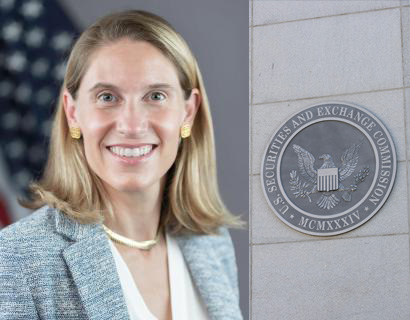
Democratic Commissioner Caroline Crenshaw’s last day at the SEC was last Friday. This means that, for the foreseeable future, the SEC will only have Republican commissioners and no Democratic commissioners even though the SEC was designed to have three members from the President’s party and two commissioners from the minority party. As a result, the SEC will be an echo chamber with a few like-minded people from the same political party with very similar views and all answering to the Republican President. Given the risks and consequences to investors, markets, and the economy, it’s worthwhile to review Commissioner Crenshaw’s many contributions to the SEC and what the SEC will miss without the benefit of diverse viewpoints.
Unregulated Private Markets’ Risks to Retail Investors
Commissioner Crenshaw joined the SEC on August 17, 2020. On August 26, 2020, she dissented from the SEC’s decision to expand retail investor participation in largely unregulated, non-transparent, and illiquid private markets, which have few of the disclosure, pricing, liquidity, redemption, or remedy rights that are the bedrock of protecting retail investors. The SEC did this by amending the “accredited investor” definition, and her dissent and warnings seem prescient today.
The SEC’s amendments expanded the number of individuals and entities who could qualify as an accredited investor to whom private market assets could be sold. Commissioner Crenshaw called the accredited investor definition “the single most important investor protection in the private market.” Thus, the SEC’s decision to weaken that protection afforded “issuers of unregistered securities access to more and more investors without due regard for the risks they face.”
Commissioner Crenshaw highlighted the following problems with the SEC’s action:
- The SEC was continuing a “steady expansion of the private market” despite private offerings lacking “the traditional investor protections that attach” to a registered public offering, such as “transparency and liquidity,” which makes them “prone to fraud.”
- The SEC failed to index the wealth thresholds for qualifying as an accredited investor to inflation, which had resulted in a 550% increase in qualifying households since 1983, and meant that private offerings could be sold to individuals who could not bear the risk of loss.
- The SEC failed to include any efforts in the amendments to enhance visibility into the private markets and thus failed to address the lack of data regarding the private markets.
Five years later, under Chair Atkins, the SEC seems determined to remove almost all limits on the ability of issuers of unregistered securities to pitch and peddle to retail investors. The SEC wants to both further expand the definition of an accredited investor so more retail investors qualify and eliminate the limitations on sale of private market securities to accredited investors. At the same time, the SEC has repeatedly delayed the implementation of a rule that would provide it greater insight into the private markets. Commissioner Crenshaw has warned that these actions all threaten retail investors. In her absence, who will warn retail investors that the SEC—the institution that is supposed to serve as the investor’s advocate—is acting against their interests?
Curtailing Investor Rights in the Public Markets
Although SEC action in the context of the private markets offered Commissioner Crenshaw her first opportunity to advocate for investors, she did not have to wait long to prioritize the interests of investors in the public markets too. One month after her dissent from the private markets accredited investor definition, on September 23, 2020, she also dissented from the SEC’s amendments to rules governing shareholder proposals. The amendments raised the thresholds for a shareholder to submit a proposal to holding $25,000 of the company’s securities for one year, up from $2,000, or $2,000 over three years, up from one year, and Commissioner Crenshaw could not support “yet another rule” that would “effectively curtail shareholders’ rights to express their views.”
Commissioner Crenshaw could not have known it at the time, but this was not the culmination of, but rather a harbinger of, the SEC’s attempts to curtail shareholder rights. Under Chair Atkins, the SEC has called into question the right of shareholders to raise their views at all. It has expressed the view that public company shareholders should receive less information about the companies they own—such as the compensation the top executives receive. And it has given permission for public companies to force shareholders into arbitration and prevent them from seeking to redress corporate misconduct by filing class action lawsuits in court. Alone amongst the Commissioners, Commissioner Crenshaw has identified the peril for investors in all of these actions.
- She noted that the shareholder proposal process is “designed merely to facilitate a dialogue with investors” and that the SEC’s actions making it harder for investors to submit proposals “drowns out investor voices and facilitates corporate monologues instead.”
- She noted that it “is a fundamental shareholder right-as the owner of a company’s equity-to obtain full and fair disclosure around the compensation of corporate executives.”
- She noted that mandatory arbitration was “another way to stack the deck against investors” by forcing harmed shareholders “to sue companies in a private, confidential forum, instead of a court and without the benefit of proceeding in the form of a class action.”
Commissioner Crenshaw described these measures as a “parade of actions . . . that will ring the death knell for corporate governance and shareholder democracy, deny voice to the equity owners of corporations, and elevate management to untouchable status.” And these were Commissioner Crenshaw’s concerns while she was on the Commission. What will happen now that she is gone?
Crypto Dangers to Retail Investors
Unfortunately, the traditional markets are not the only area in which Commissioner Crenshaw has had to alert investors to the fact that the SEC is no longer on their side. Two years ago, on January 10, 2024, the SEC approved the listing and trading of spot bitcoin exchange-traded products (ETPs). Commissioner Crenshaw warned that this action might be in the interest of the crypto industry and sponsors of the ETPs but was not in the interest of investors, markets, and the public.
Commissioner Crenshaw expressed the following concerns about the SEC’s action:
- Spot bitcoin ETPs would “flood the markets and land squarely in the retirement accounts of U.S. households who can least afford to lose their savings to the fraud and manipulation that appears prevalent in the spot bitcoin markets and will impact the ETPs.”
- The approval of spot bitcoin ETPs would lead to the approval of even “more speculative products bearing greater risks of investor harm” with investors paying the price.
- The approval of spot bitcoin ETPs would “provide the previously attenuated nexus to traditional markets that allows crises in largely non-compliant crypto markets to spill over.”
Again, Commissioner Crenshaw’s remarks seem prescient. She worried that the approval of spot bitcoin EPTs put the SEC “on a wayward path that could further sacrifice investor protection.” Today, the SEC has rendered investor protection completely subservient to the interests of the crypto industry. In addition to opening the floodgates to other crypto ETPs, the SEC has spent the last year promoting crypto at every turn. Yet crypto remains incredibly volatile, with a recent downturn wiping out over $1 trillion across the crypto world. As Commissioner Crenshaw feared, smaller retail investors have borne the brunt of this downturn. And the entanglement of crypto with the traditional financial system means that crypto now poses systemic risks. Commissioner Crenshaw has too often been the lone voice warning that crypto has a notoriously high risk of loss. Who will stand up to the crypto industry at the SEC now that she is gone?
Unleashing Tokenization Without Guardrails
Commissioner Crenshaw’s departure also means that the crypto industry may get what it wants on the related, but distinct, issue of tokenization. Perhaps recognizing that there is no real-world use case for crypto itself, the crypto industry and the SEC now want to move all traditional securities onto the blockchain. Although tokenization may have some benefits if done right, that is unlikely to happen without voices urging that appropriate guardrails be in place when it comes to tokenization.
Commissioner Crenshaw has been exactly that voice. In the context of tokenization, she has said:
- The SEC’s “efforts to facilitate adoption of blockchain, let alone specific forms of it, seem like the government picking winners and losers,” and that the SEC seems to be doing so “before the technology has even been demonstrated fit for purpose.”
- Although proponents argue that “tokenization can speed up the settlement of trades and make markets more efficient, the settlement cycle, while shorter than it used to be, is a design feature, not a bug, and the “intentional delay built in between trade execution and settlement provides for core market functionalities and protection mechanisms.”
- The SEC should “exercise extreme caution with potential changes of this scale, which historically have been undertaken only to address true market crises,” and should ensure that tokenization mainly impacts “the portion of the market that participates in crypto—recently estimated to be less than 5% of U.S. households—and [is] not detrimental to the ‘TradFi’ markets on which most Americans depend for their financial well-being.”
In a nutshell, Commissioner Crenshaw questioned why it is necessary to tokenize securities. The SEC should not promote tokenization because that is what the crypto industry wants; it should do its job and protect investors, and it is not clear that investors have any need for tokenized securities. In the absence of anyone on the Commission to represent the interests of investors, however, investors may get tokenized securities whether they need or want them or not.
Handcuffing Enforcement by Killing the Consolidated Audit Trail
Commissioner Crenshaw’s absence also threatens SEC enforcement. That’s because, for the last year, she has been the lone voice sounding the alarm about Chair Atkins’s seeming determination to dismantle the Consolidated Audit Trail (CAT). The CAT is a repository of all data about a securities transaction and thus enables the SEC to monitor markets and more easily catch crooks.
Although the CAT should be “a regulator’s dream,” the SEC has spent the last year limiting the CAT’s usefulness. This started in February 2025 when the SEC ordered that the CAT no longer needed to collect the names, addresses, or years of birth of most natural persons. The result of the order is that it will be harder for the SEC to detect misconduct and identify the perpetrators.
Commissioner Crenshaw highlighted the reasons why this action was inexplicable:
- She said that the CAT “helps make our markets safer” and “more efficient” since it is “a powerful tool in ferreting out wrongdoing” but the SEC was undermining “its use and our own effectiveness” by “wiping away the fingerprints from the scene of the crime.”
- She said that for “quick and effective oversight in a crisis” the SEC needs “access to a timely and comprehensive set of data” and that by eliminating “the CAT’s collection of the most basic customer identifying information” the SEC was impairing its own “ability to understand suspicious activity, unwind events, or stave off market disruptions.”
- She said the CAT is “a seminal example of how data collection can be used for good purpose” and that the SEC’s action was “a loss for markets and investor protection.”
This concern for investor protection is glaringly absent from Chair Atkins’s repeated statements about the CAT. He couches his desire to dismantle the CAT in concerns about the CAT’s costs, despite the fact that the costs of the CAT pale in comparison to the revenue of the industry that the SEC must regulate as well as the size of the markets that the SEC must monitor. Now that Commissioner Crenshaw is no longer on the Commission, there is nobody there to point out that the SEC’s mission is not to increase the financial industry’s profits but to protect investors.
Conclusion: The SEC Is Increasingly Anti-Investor
Commissioner Crenshaw’s last speech as a member of the SEC contained a warning. She noted that, over the last 90 years, investors who bought and held “plain vanilla diversified products based on investment advice that is provided in their best interest” have generally gotten “more money out than they put in.” Due to Chair Atkins’s aggressive appetite for deregulation, however, the current environment now resembles “the period prior to the stock market crash of 1929.”
[I]nstead of safeguarding our markets for investors to fund their retirements in safe and sustainable ways, we are moving in a direction where markets start to look like casinos.
As Commissioner Crenshaw noted, the problem with casinos is that “in the long run the house always wins.” Yet the SEC is supposed to ensure that in our financial markets investors have the chance to win too. An SEC with only commissioners from one political party and wCommmissioner Crenshaw FS 01.06.26ithout diverse viewpoints and inputs like Commissioner Crenshaw’s—one that fights for investors and not for the industry the SEC is supposed to regulate—makes this far less likely.
Image: Shutterstock


